

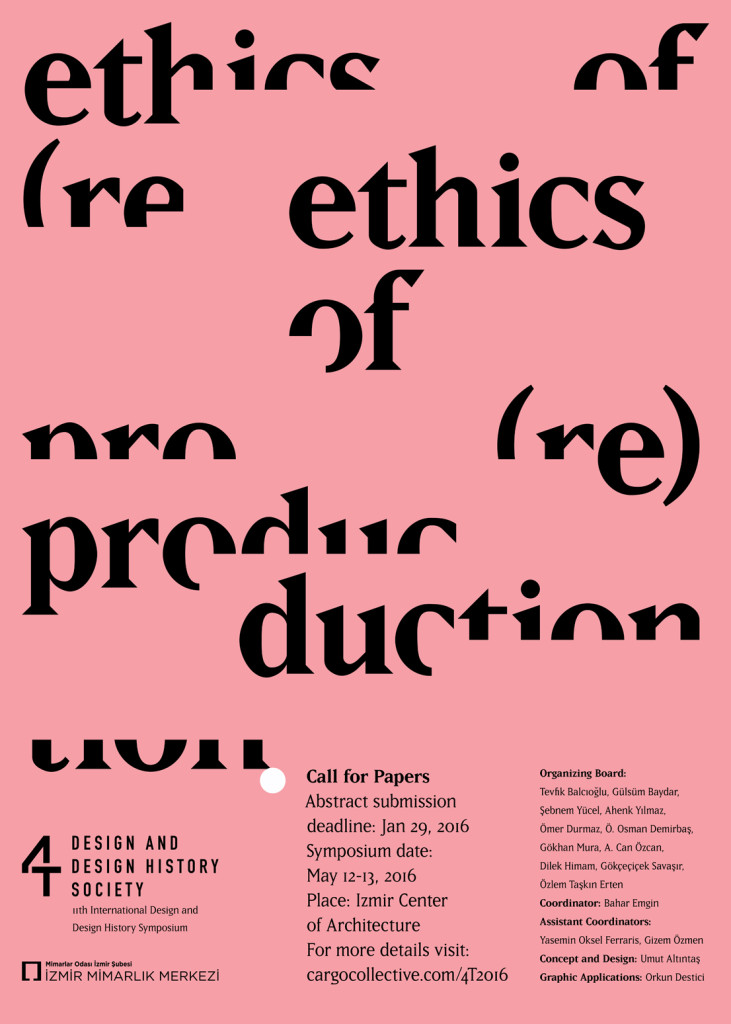
Yeniden Üretimin Etiği
Tarih ve Tasarım Derneği tarafından 12 – 13 Mayıs 2016 tarihleri arasında “Yeniden Üretimin Etiği” başlıklı bir sempozyum düzenleniyor. Sunumların da İngilizce yapılacağı sempozyum için katılımcıların İngilizce yazılmış özet metinlerini https://easychair.org/conferences/?conf=4t2016) adresine üye olarak 29 Ocak 2016 tarihine kadar göndermeleri gerekiyor.
4T2016
DATE: May 12-13, 2016
VENUE: İzmir Center of Architecture
THEME: 4T 2016 ETHICS OF [RE] PRODUCTION
“Our era prefers the images to the things, the copy to the original the representation to the reality, appearance to being.” (Feuerbach, The Essence of Christianity, 1857)
Feuerbach’s pronouncements marks the symptomatic loss at the heart of modern experience: loss of tradition, loss of the Creator, loss of a connection one formed with what one produced, and loss of a solid ground. These losses were mediated through the hopeful belief on human rationality, science and progress.
It was ironic that, despite the radical changes, this new era did not challenge the traditional belief in the singularity of Truth and reality, but simply replaced its referent from metaphysical to scientific. New developments, however, initiated questions on this singularity, starting with the invention of photography, blurring the boundaries between the original and its duplicates, the real and the appearance of the real, scientific documentation and artistic representation. In this framework, Feuerbach’s statements in the “Essence of Christianity,” were more than a discussion on religion, but an embodiment of the frustrations and alienation an individual felt in the modern era with all its novelties. Not surprisingly, this quote was used extensively in visual studies in the twentieth century.
A century after Feuerbach, as the belief on the Truth is abandoned, and the discourse on multiple realities began, philosophers like Baudrillard and Deleuze re-addressed these questions in different ways. Their discourse was no longer based on a singular, mechanical, and modern world but one that became multiple, digital and postmodern. In one century, as our experience of the world turned more fleeting, so did the production systems, transforming from manual to mechanical and to digital, challenging materiality, authorship and permanence. While the beginning of the twentieth century witnessed discussions on whether mass production systems were impoverishing art or were they finally presenting opportunities for the realization of “total work of art,” the twenty-first century seemed to have left its high aspirations behind and fully immersed itself in the aestheticization of the capitalist experience.
So what happens to the question of ethics all through these transformations? Do we still need to demarcate the line between an original and the copy when reality itself is suspect? Or is it even relevant to talk about the original? Where do we locate the producer, the product, the process and the client/spectator in this discussion? What are the emancipatory design practices that our new era allows that were not a possibility before?
This year’s symposium focuses on the ethics of [re-]production in design and throughout design history. Papers are invited to focus on one of the following thematic categories or their intersections in the context of different fields including but not limited to design and cultural studies.
RE-PRODUCTION OF IDENTITY: ORIGINAL, COPY, MIMICRY
How can the relationship between original and copy be re-interpreted in the digital age? What are the cultural implications of the cult of the original in modern societies? What is the impact of design in the construction and production of identities? How can mimicry be used as an ethical design strategy? How does the fluidity of digital age mobilize fluidity of identities?
RE-PRODUCTION AND AUTHOR-ITY:OPEN SOURCE, CO-CREATION, HACKING
“What is an author” in the digital age? How can hacking be ethically located in the field of design? What is the role of open source initiatives in design? What are emancipatory potentials of co-creation today? How design can be organized as a cooperative process?
RE-PRODUCTION AS REALITY, SIMULATION, HYPER-REALITY, AUGMENTED REALITY
How do representations produce social and cultural realities? To what extent does design contribute to the management of perception? What are the potentials of simulacrum as a denial of the original / copy model? How are virtual and simulated environments consumed in contemporary societies? What are the ethical issues that are mobilized in new understandings of reality?
CALL FOR PAPERS
Those who are interested in contributing papers to the eleventh 4T Symposium are invited to submit a title and an abstract of 250-300 words through Easy Chair https://easychair.org/conferences/?conf=4t2016) by January 29th 2016. Registration to Easy Chair is essential in order to submit abstracts. The symposium language is English, therefore all abstracts, presentations and papers should be in English. For any further questions please contact Bahar Emgin (bahar.emgin@yasar.edu.tr). Selected proposals will be announced on February 29th, 2016.
ORGANIZING BOARD
Tevfik Balcıoğlu, Gülsüm Baydar
Şebnem Yücel, Ahenk Yılmaz
Ömer Durmaz, Ö. Osman Demirbaş
Gökhan Mura, A. Can Özcan
Dilek Himam, Gökçeçiçek Savaşır
Özlem Taşkın Erten
COORDINATOR
Bahar Emgin
ASSISTANT COORDINATORS
Yasemin Oksel Ferraris, Gizem Özmen
CONCEPT AND DESIGN
Umut Altıntaş
GRAPHIC APPLICATIONS
Orkun Destici
Scientific Committee
Ahenk Yımaz, Yaşar University
Ahmet Zeki Turan, Mimar Sinan Fine Arts University
Ali İlhan, Özyeğin University
Alison J. Clarke, University of Applied Arts Vienna
Anna Calvera, University of Barcelona
Aren Emre Kurtgözü, MEF University
Artemis Yagou, MHMK Macromedia University for Media and Communication
Arzu Vuruşkan, İzmir University of Economics
Ayşe Coşkun Orlandi, Kadir Has University
Burkay Pasin, İzmir University of Economics
Çiğdem Kaya, İstanbul Technical University
Deniz Hasırcı, İzmir University of Economics
Didem Kılıçkıran, Kadir Has University
Dilek Himam, İzmir University of Economics
Dilek Kaya, Yaşar University
Duygun Erim, Yaşar University
Eduardo Corte-Real, IADE
Elçin Tezel, Bahçeşehir University
Erdem Erten, İzmir Institute of Technology
Fedja Fukic, University of Zagreb
Fehmi Doğan, İzmir Institute of Technology
Figen Işık, Middle East Technical University
Gökhan Mura, İzmir University of Economics
Grace Lees-Maffei, University of Hertfordshire
Gülay Hasdoğan, Middle East Technical University
Gülname Turan, İstanbul Technical University
Gülnur Ballice, Yaşar University
Gülsüm Baydar, Yaşar University
Hakan Ertep, Yaşar University
Haruhiko Fujita, Osaka University
Harun Kaygan, Middle East Technical University
Héctor Flores Magón y Jiménez, University of Guadalajara
Helena Barbosa, Universidade de Aveiro
Hilde Heynen, KU Leuven
Işıl Oygür, Bahçeşehir University
J.C. Gimeno Martinez, Vrije Universiteit Amsterdam
Jeremy Aynsley, University of Brighton
Jonathan Woodham, University of Brighton
Kıvanç Kılınç, Yaşar University
Kjetil Fallan, University of Oslo
Lucila Fernández, ISDI, Instituto Superior de Diseño Industrial
Marinella Ferrara, Politecnico di Milano
Neslihan Dostoğlu, İstanbul Kültür Üniversitesi
Ö. Osman Demirbaş, İzmir University of Economics
Oscar Salinas Flores, Universidad Nacional Autónoma de México
Özlem Savaş, Bilkent University
Özlem Taşkın Erten, İzmir Metropolitan Municipality
Paola Ardizzola, International Antalya University
Paul Atkinson, Sheffield Hallam University
Pekka Korvenmaa, Aalto University
Pınar Kaygan, Middle East Technical University
Pınar Yalçın, İstanbul Technical University
Priscila Farias, Universidade de São Paulo
Robert Lzicar, Bern University of the Arts
Şebnem Timur Öğüt, İstanbul Technical University
Şebnem Yücel, Yaşar University
Serkan Şavk, İzmir University of Economics
Tevfik Balcıoğlu, Yaşar University
Vanni Pasca, University of Politecnico
Viviana Narotzky, ADI-FAD
Wendy Wong, York University
Wolfgang Jonas, Braunschweig University of Art
Yuko Kikuchi, University of the Arts London
Zuhal Ulusoy, Kadir Has University
