Terk edilmiş: yanıt, araştırma ve yansıma
Meraklarımız, beklentilerimiz ve hayal gücümüzle baktığımızda alışık olmadığımız formların ve belirgin zıtlıkların olduğu bir dünyaya gireriz.
Gerçek dünya böylesine keskin siyah ve katıksız beyaz tonlarda görüntüler sahneler mi bilinmez. Muhtemelen doğadaki renk kullanımı bu etkileyici tonları baltalayacaktır. Bu tonlar ise geçmişin siyah beyaz sinema filmlerinin dram duygusunu çağrıştırıyor.
Görünürde herhangi bir canlı belirtisi olmasa da, dram o görüntülerde, açılar ve yüzeylerin, biçimler ve gölgelerle olan diyaloğunun terkedilmiş mekanların anlamlılığına olan düşkünlüğündedir /bağımlığındadır.
Acaba neredeyiz? Hangi esrarengiz ya da özel dünya buraya benzeyebilir? Bu görüntülerin dünyasına girersek bizi neler bekler?
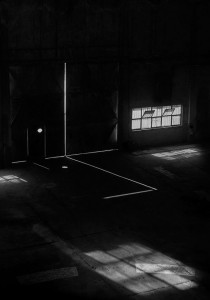
Beyaz ışık; pencere camlarının parmaklıklarının arasından, uçsuz bucaksız, sessiz ve karanlık mekanların içine doğru, şiddetli huzmeler ve gölgelerle yolunu buluyor. Gölgeler aralıklardan sızan daha da parlak ışıklarla birlikte ışık parçacıklarını çevreliyor. Cam, metal ve ahşap birarada gizemli dokular oluşturmuş. Etrafta artık kullanılmayan makine parçacıklarını farkediyoruz. Bir pencerenin dışındaysa büyük bir vinç var, fakat muhtemelen hareketsiz, terkedilmiş olduğu aşikar tüm bu mekan gibi.
Geçirgenliğini yitirmiş camların arasından görünen ağaçların tüyümsü biçimleri metal çubukların sert çizgilerini belirginleştiriyor.
Bir insan figürü gördüğümüzde, bir afetin ardından terkedilmiş bu yere giren ilk kişiye bakar gibiyiz. İnsan formu uzakta dikdörtgen beyaz bir ışıkla çerçevelenmiş; bu aslında açık bir kapı. Önündeki alan alabildiğince uzanıyor ve kapıdaki figür neredeyse alanın orantısız yoğunluğuyla eziliyor.Toz kokusunu sanki burnumuzda hissediyoruz.
Derlemedeki anlatımlar çağrışımlarıyla bizi bu yer hakkında meraklandırırken, görüntüler form, çizgiler ve ışık haline bürünmüş bir meditasyondan daha fazlasını sunuyor.
Fotoğraflar bizi gölgenin biçimle, ışığın yüzey ve açılarla olan etkileşimi üzerinde düşündürüyor. Tüm bunlar, görüntülere gerçekliği bilinen yerlere ve eşyalara dayanmayan türde kompozisyonlar ve soyutluk kazandırıyor. Bu fotoğraflar, sanatçının sevdiği heykel ve soyut resim gibi diğer sanat formlarının yakın akrabaları.
“Terk edilmiş” deki fotoğraflar İstanbul’un kullanılmayan ve düşük kapasiteyle kullanılan iki tarsanesinde çekilmiş.1455 de inşa edilen, dünyanın ikinci eski tersanesi olan Haliç Tersanesi ve zamanının önemli tersanelerinden Cami Altı Tersanesi.
Fotoğrafçı Timurtaş Onan, bu yerlerde taptaze bir ilham bulmuş kendine. Terk Edilmiş, daha önceki çalışmalarının hem devamı hem de onlara bir veda niteliğinde… İstanbul’da mekanlar ve insanlar üzerine önceki çalışmalarıyla tanınan sanatçı “Terk Edilmiş”te, o eşsiz atmosferi çok az bilinen bir yeri keşfe çıkmış. Eskiden beri form ve ışığa önem veren bir fotoğrafçı olarak “Terk Edilmiş”te Onan, bu hassasiyetini ön plana çıkarmış. Daima kendine özgü yerlerin ruhunu yakalama yeteneği olan fotoğrafçı bu kez“Terk Edilmiş” ile eski tersanelerin atmosferini keşfe çıkmış.
Küresel eğilimde olduğu gibi, bugünlerde böyle tersaneler ya çok düşük kapasiteyle çalışmakta ya da satılmaktalar. Bir zamanlar büyük faaliyet içinde, çok sayıda teknenin inşa edildiği yerlerken günümüzde deniz nakliyatı yerine karayolu nakliyatına önem verilmesiyle böylesine geniş alanlar kullanılmadan, bakımsız halde bırakılmıştırlar. Bu yüzden fotoğraflarda boşluğun ve terk edilmişliğin izleri görülmektedir.
Fotoğrafçının niyeti öykü anlatmak veya sosyal ve tarihsel bir belgesel çalışması yapmak olmasa da, bu görüntülerde tarihin ve değişimin çok güçlü yankıları duyulur.
Her şeyin ötesinde, bir sanatçı olarak Onan, bu yerlerde bakış açısını ve anlatım ustalığını sergiliyor. Bu ıssızlık da bir güzellik var, bu duyulmamış ıssız yerler formlar ve dokular insanı çeldiren bir şeyler barındırıyor. Fotoğraflar, izleyiciyi düşünmeye ve büyülenmeye, huşu ve merak içine çekerek hayal gücü ve fantazilerini uyarmaya ve böylece içsel dünyalarına ayna tutmaya davet ediyor.
Dönüp arkamıza baktığımızda, dünya farklı görünecektir.
Inez Baranay
_____________________________________________
Abandoned: response, research and reflection
As we enter, with our eyes and imagination, with our curiosity and expectation, we find ourselves in a world of unfamiliar forms and distinct contrasts.
I’m not sure that real life ever produces quite the stark black and white tones of these images. The expressiveness of these tones would be diminished by the use of colour. They arouse a memory of certain black and white cinematic films of an earlier time; they bestow a sense of drama.
And yet there is almost no organic life evident: the drama is in the images themselves, in the engagement with the dialogue of angles and surfaces, with shapes and shadows, with the suggestiveness of abandoned spaces.
Where can we be? What mysterious and particular world looks just like this? What occurs to us as we enter into the world of these images?
White light finds its way through a grille over window panes, into vast silent dark halls heavy with beams and shadows. Shadows frame a grid of bright patches cast by even brighter light strained through more grids. There are intriguing textures, of glass and metal and wood. Here and there we can make out what seems to be disused bits of machinery, and outside one window there’s a huge crane, but it is probably motionless, apparently as abandoned as all this area has been. Where trees are seen through opaque glass, their feathery shapes accentuate the emphatic lines of metal bars.
When we see a human figure it’s as if we were looking at the single person who has entered this space since some catastrophe made its inhabitants flee, or drift away. The human figure is framed by a distant oblong of white light; it’s an open door. The space in front of him stretches empty in all directions; the proportions overwhelm him. We can almost smell the dust.
While narratives suggest themselves in this collection, and our curiosity about the location is aroused, the images are really more of an extended meditation on form, line and light.
The photographs make us contemplate the interplay of shade with shape, light with surfaces and angles. It gives to these images something of abstractions, of compositions whose effects do not entirely rely on the recognition of actual places and things. These pictures are close relatives of the other art forms the photographer loves, sculpture and abstract painting.
The photographs in Abandoned were taken in disused old shipyards in Istanbul: the Haliç Tersanesi, which, established in 1455, is the second oldest in the world, and the Cami Altı Tersanesi, which was also an important yard in its time.
In these spaces photographer Timurtaş Onan found fresh inspiration. Abandoned is both a continuation of and a departure from the work he has done before. Known for his previous work on places and people in Istanbul, in “Abandoned” he explores a little-known territory for its unique atmosphere. Always a photographer with an eye for shapes and light, in “Abandoned”Onan makes these preoccupations his central concern. Always a photographer with a gift for capturing the particular essence of specific places, in “Abandoned” he explores the atmosphere of old shipyards.
Typical of the global trend, these days these shipyards work at a much lesser capacity or are sold off. Once they were hives of activity, with huge numbers of boats being built and repaired, but now, with the decline of water transport in favour of road transport, vast spaces are left unused and untended.
Therefore evidence of emptiness and abandonment are found in these pictures. Even while the photographer’s intention is not to tell stories, and certainly not to provide work in the genre of social documentary, history and change are powerful resonances in these images.
It is as an artist above all that Onan brings his perceptive and expressive skills to these locations. There is beauty in this desolation, intrigue in the forms and textures found in these little-known and largely forsaken locations. The photographs here invite the viewer into states of contemplation and fascination, even wonder and awe, to find one’s imagination and fantasy stimulated, to find one’s inner states mirrored and evoked.
When we have to turn away, the world looks different.
Inez Baranay