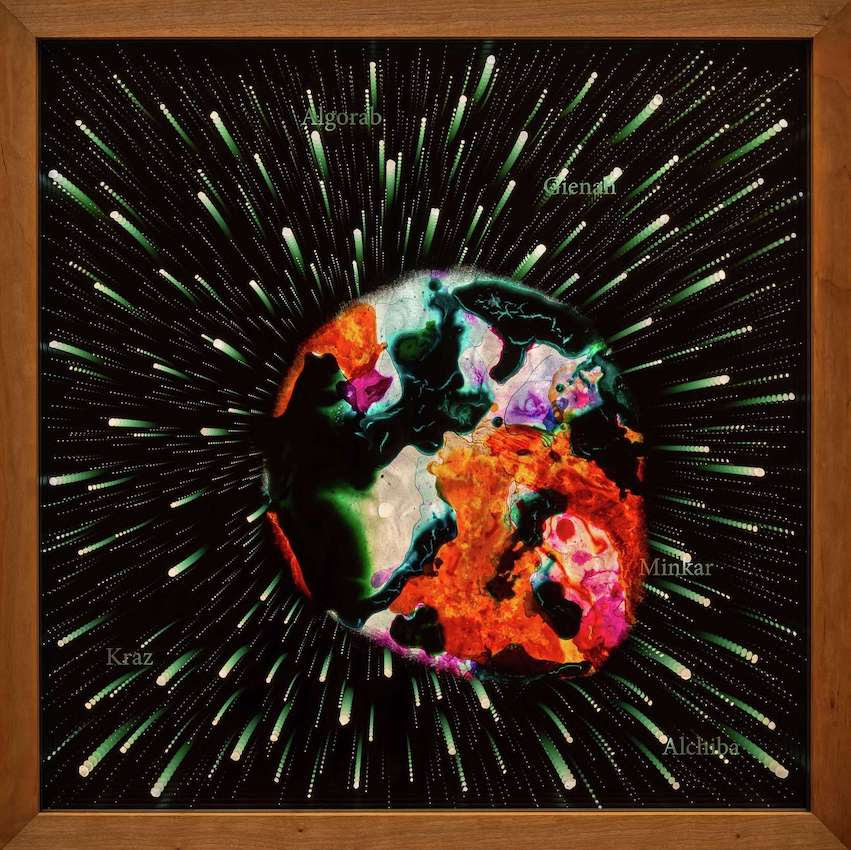
TEMPLON New York’s group exhibition Cosmography brings a poetic exploration of the cosmos featuring works by gallery artists Abdelkader Benchamma, Will Cotton, Jitish Kallat, Iván Navarro, and Chiharu Shiota, along with other artists including Laurent Grasso, David Huffman, Chris Martin, Mariko Mori, Toshiko Takaezu, and De Wain Valentine.
Cosmography, the scientific study of mapping the general features of the universe, is a field which incorporates geology, geography, and astronomy. These artists stretch the limits of science and belief through interdisciplinary examinations of mythology, history, and mathematics. Webbed surfaces, geological strata, and explosive nebulae mimic the undulating mysteries of the celestial world, while paralleling human networks; blood vessels, sacred geometries, and invisible connections of shared memory materialize the cosmos within a micro universe. They lay forward humanity’s attempt to apprehend the infinite by naming, mapping, and recording large-scale phenomena.
Working at the intersection of technology and spirituality are Mariko Mori, De Wain Valentine, Laurent Grasso, and Iván Navarro. While appearing supernatural or miraculous, these works emphasize their human-made industrial elements. Cross-examining technology and spirituality, Mori adopts a cyborg identity within technological environments. With a simplicity and grandeur reminiscent of the mid-century Futurist aesthetic, the works of Valentine maintain their sense of cosmic import decades after their creation, calling upon a universal vision of the future. The illusions created by Grasso manufacture a state of consciousness to explore uncertainty, materializing the space between the visible and invisible. Navarro’s reproductions of chimeric celestial bodies are scattered with their human-given labels, emphasizing humanity’s efforts to claim the cosmos.
Human intervention in mapping the universe is a subject shared by Jitish Kallat, Abdelkader Benchamma, Chiharu Shiota, and Toshiko Takaezu. Using both geometric and organic forms, these representations serve as abstractions of space, time, and invisible cycles. Kallat’s research into transience and subsistence combines data and abstraction to conceptualize the universe. Reminiscent of unstable vortexes and whirlpools, Benchamma’s inky formations ask to be deciphered like a Rorschach test. Shiota uses threads of black and red to create inextricable webs, symbolizing human networks and crystallizing miniature universes. Takaezu also envisions objects as a metaphor for the internal human universe with her “closed forms,” which are both singular and collective, mysterious and powerful.
David Huffman’s abstracted surrealist worlds interweave natural and celestial imagery. Spiritual motifs like emblems of Egyptian mysticism and Afrofuturist imaginings act as guiding points for his reflection on the universe’s expansiveness and our connection to it. Inspired by the notion of a shared spirituality, Chris Martin investigates the spectrum between the eternal and the present, the vast and the intimate. Will Cotton’s crafted utopias open the door to new realities in which humans play a central role. These artists explore a surrealist, cosmic vision of the future, one that is ripe with personal histories and occasions for change. These metaphysical works contemplate our relationship to the intangible structures that bind our universe and equally suggest an internal, perhaps spiritual, study of the worlds within us.
For all inquiries, please contact the gallery at inquiry@templon.com