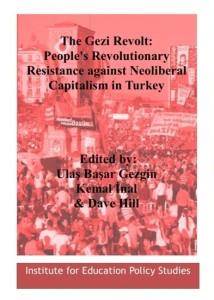
Gezi Park, Taksim Square, Istanbul- May-June 2013. Images and news spread round the world, images of violent police repression, tear gas, ‘the woman in the red dress’, water cannon, against an amazingly diverse array of peaceful protesters. The protests were unprecedented in scope in Turkey.
“The attack is disproportionate, we need your help!” Many of us rushed to Gezi Park on 31st May 2013 responding to phone calls, to social media, to our friends’ calls for help. Others, especially the members of the loosely connected platform, Taksim Solidarity were already there as early bearers of the revolutionary spirit. Gezi Resistance was preceded by the Gezi Park Festival on 13th April 2013 where protest music groups performed for free to address all who appreciate the significance of green areas in cities and who are not willing to bow into submission, when a sultan, a government, a Prime Minister Erdogan issues a decree. The growth of the resistance movement- which spread across Turkey- was gradual, it developed, strengthening with each government and police provocation. Some of the audience were the seasoned politicians of the streets and squares, some of them were the ‘retired generals’ of the older generation who suffered under Fascism/ the military dictatorship in Turkey of 1980-83 and had lost hope in any sort of social change; while others were of the much admired current wave of protesters, born in the 1990s. Some of us rushed to protect the trees in Gezi Park, a symbol of public space, of `the public’, threatened with destruction in the name and pursuit of the glorification of consumption. Some of us were angered by police violence, and yet some others saw this as a sort of socially-rooted festival. We set up our tents and built up a miniature society we have dreamt of for long, with its ‘revolution market’, ‘museum’, ‘wish tree’, ‘infirmary’, ‘organic garden’, ‘library’, ‘school’, ‘public university’, ‘hair dresser’, ‘TV channel (Chapul TV)’, ‘radio broadcasts’ so and so forth.
In this collection of essays and reflection, we present a detailed portrait of Gezi not only as a an act of resistance but as an intentional community that will serve as a beacon for generations in Turkey to come- and, globally, more widely- as examples of resistance to neoliberal and neoconservative and Fascist assault, through chapters by local and international left politicians, activists and academics, providing a deeper insight to Gezi and social movements. As “this is just the beginning”, as we “continue the struggle”; this book is also a beginning, an open text that will never be concluded until the demise of the societies of inequality and injustice.