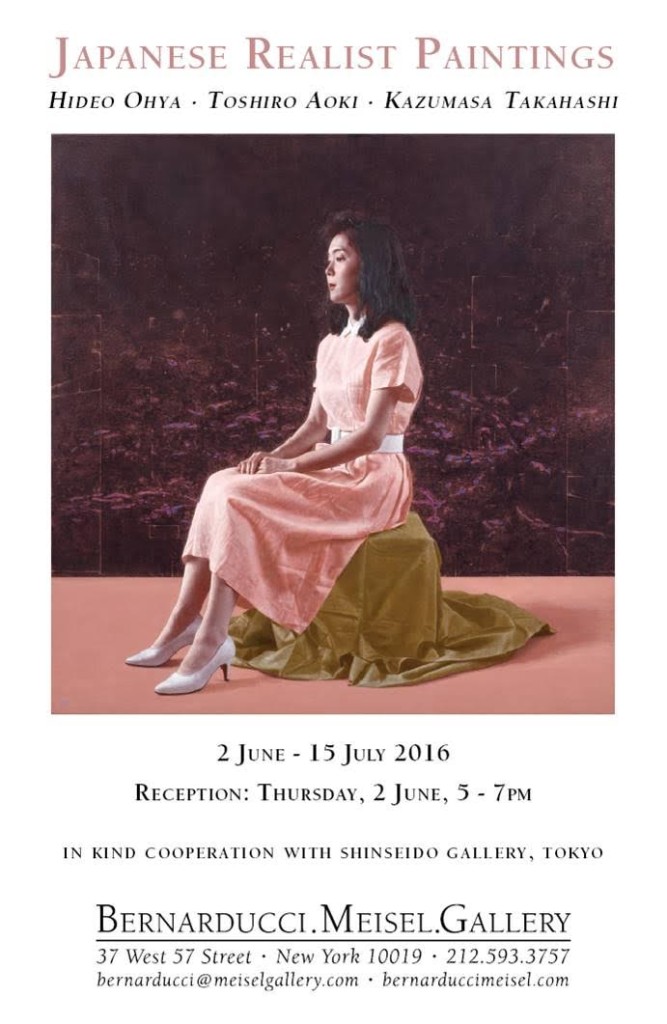
JAPANESE REALIST PAINTING
HIDEO OHYA – TOSHIRO AOKI – KAZUMASA TAKAHASHI
IN KIND COOPERATION WITH SHINSEIDO GALLERY, TOKYO 2 JUNE – 15 JULY 2016
Bernarducci Meisel Gallery is pleased to present a first look exhibition entitled Japanese Realist Painting featuring works by HIDEO OHYA, TOSHIORO AOKI, and KAZUMASA TAKAHASHI. The exhibition it is an intimate look at six intricate paintings by these prolific Japanese painters. Their work has never before been exhibited in the United States and was first discovered by Frank Bernarducci when he visited the Hoki Collection in Japan.
Ohya’s portraits of young women like The Day of Spring Finished II (2000) anthropomorphize the fleeting seasons, sounds, or actions in the women’s expressions. This painting evokes the end of spring. The sitter is a young Japanese woman and appears to forlornly reminisce the rebirth of nature. We only see her profile from the elbow up. Her hair is pulled back in a bun and her gaze is lowered as she proudly keeps her long neck up. She is wearing a white cotton blouse, the texture of which, the artist so expertly painted. She is in front of an abstract red background. The slight abstractions feature textural variations in color and are a stark contrast to her pale white skin.
Red Minor Chord (2003) by Ohya is a painting of another young Japanese woman. Her dark hair frames her face and falls over her shoulders as she turns to the viewer, glancing down at us. There is an abundance of power in her gaze and stance. She is wearing a loose white long sleeved blouse. Her figure is contrasted by an enormous red, black, and yellow wing of a monarch butterfly. The wing may be part of a traditional Japanese mural. The sitter is anthropomorphizing the ominous sounds of a minor chord with her all-knowing glance.
Also on view is a still life by Toshiro Aoki entitled Small Bowl of Camellia (2015), a painting of a traditional Japanese porcelain bowl with blue patterns, holding red and white camellia flowers. In Japanese culture, red camellia flowers are symbolic of love and white camellia flowers are symbolic of waiting.
Kazumasa Takahashi’s Yukata (2011) is a portrait of a young woman smiling and looking past the viewer, over her shoulder. She is wearing a traditional Japanese Summer Kimono called a Yukata. She has an Amaryllis flower in her hair, which in Japanese culture, signifies bashfulness. Like the flower in her hair, the kimono’s designs also symbolize aspects of her personality and essence.
Ohya was born in Tokyo and received his MFA from the Tokyo University of the Arts. His work has been featured in exhibitions at the Nara Prefectural Museum. He has been awarded the Showa Kai Award and Yasui Award.
Aoki was born in Kyoto, Japan and studied at Tokyo Zokei University and the Royal Academy in Ghent. He won the Yasui Award and has exhibited at Yamatane Museum of Art, The Museum of Kyoto, and Suwa City Museum of Art, among others.
Takahashi was born in Saitama and studied at Nihon University. He has been awarded the Citizen Award, Onward Gallery Award, and Toho award. His work has been included in Nerima Art Museum, the Hoki Museum, and Shinseido Gallery, among others.
BERNARDUCCI.MEISEL.GALLERY
37 West 57 Street . New York 10019 . 212.593.3757
bernarducci@meiselgallery.com . bernarduccimeisel.com
For more information contact Marina Press at (212)593-3757 or marina@meiselgallery.com.