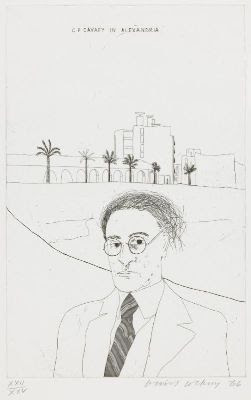
This summer, Anita Rogers Gallery will present an exhibition of David Hockney’s 1966 series, Illustrations for Fourteen Poems from C.P. Cavafy, along with daily (Monday-Saturday) screenings of James Scott’s Love’s Presentation (1966), a short film documenting Hockney as he works on the Cavafy etchings. The gallery will also host select screenings of other art films by James Scott, including Every Picture Tells a Story (1984) about his father William Scott, The Great Ice Cream Robbery (1971) (featuring Claes Oldenburg with Hannah Wilke) and Richard Hamilton (1969). Showtimes, including weekend and evening screenings, are available on the gallery website.
James Scott, March 2019:
The question I am often asked is, “How did you come to make a film on David Hockney featuring his illustrations of Cavafy poems?”
The answer is simple and straightforward. My dream as a young filmmaker was to tell stories and use actors to do this. I believed the great films of all time were human stories full of emotion and drama. Although brought up in a family of artists, my ambition was to become a film director – not a painter or sculptor. However as a young filmmaker with a family to support, I began to see that there might be a viable future in making films about living artists that could both inform and entertain. And so was born the first of my ‘art’ films – a film on the young David Hockney.
With an almost non-existent budget, I realized that I could make a black and white film using minimal lighting and no sound or music that followed David while working on this project. Effectively this was a story about the meaning of work itself, and how looking at the craft of an artist could reveal not only the artist’s magic but also the underlying emotion that drives the creative moment. Besides showing in detail the process of making an etching, the film would also express something about the character of David himself. I was less interested in the ‘personality’ of the artist, the bleached hair and the gold lame jacket, but more in the human being.
In choosing to illustrate these particular poems of Cavafy, David was also choosing the theme of homosexual love, which at the time was still a highly controversial subject. This film presented the possibility of following the intertwining paths that an artist follows, on one side, his craft and on the other, his own personal story. As Hockney says in the opening sequence, “I know more about love than I do about history.” Poetry and drama combined within what is ostensibly a ‘how-to’ film. Having followed the intricacies and techniques behind the making of an etching, the film ends with a sequence showing the fruits of his labour. As Hockney recites some of Cavafy’s poems in conjunction with his own illustrations, we become aware of the magic and beauty of Love’s Presentation, the title of the film.
For me, this is the epitome of my practise; to bring the experience of the actual work into direct relationship with viewing the film, a time-based medium. I learned through making this super low-budget art documentary that drama could be found on any level. I had discovered some of the most intensely emotional and dramatic films were often the ones that were the quietest and the least strident; for example, the films of Yasujirō Ozu and Robert Bresson, and the plays of Harold Pinter.
More than fifty years after Love’s Presentation was made, I came across some old boxes of magnetic tape in a forgotten cupboard. It turned out that these were some of the original recordings that I made with David reciting the Cavafy poems. Now, for the first time in the US, it will be possible to see the original etchings while simultaneously hearing David’s voice; a unique opportunity to gain insight into this great artist’s creative process.
Above:
David Hockney, Portrait of Cavafy in Alexandria, 1966, Etching and aquatint on paper, 13 13/16″ × 8 7/8″
Part of Illustrations for Fourteen Poems from C.P. Cavafy
Work on loan courtesy of the The David Hockney Foundation
©David Hockney