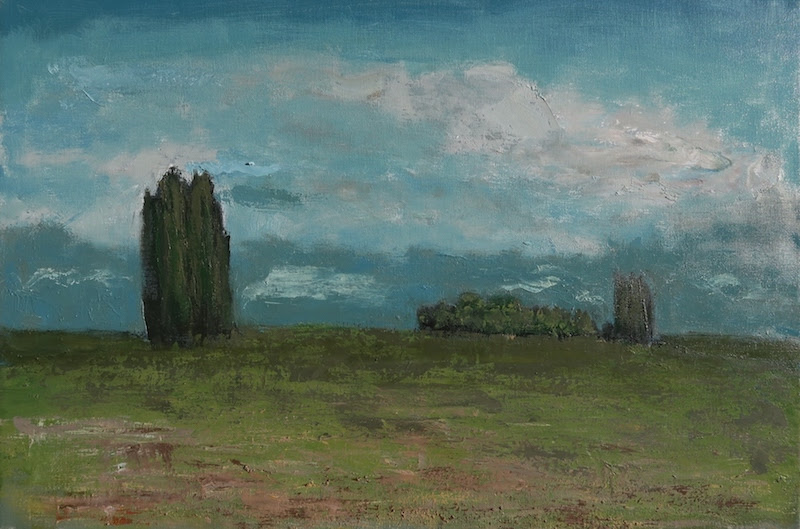
HUGO GALERIE is pleased to present Juxtapositions: Bulgaria, the first of the Juxtapositions series showing a pair of the gallery’s artists in order to more fully realize their similarities and differences of style, subject, and setting. This exhibition features Bulgarian-born artists Albert Hadjiganev and Christa Kirova.
Hadjiganev invites viewers into his expansive canvases of thickly layered paint where the brushstrokes and knife cuts are tangible evidence of his presence and unyielding attention to detail. His reworking of the paint is never tired; Hadjiganev’s natural palette maintains its distinctive glow: lucid and serene, never muddy. You become present and easily lose yourself within his bucolic and immersive landscapes. Leaves sway in the forest breeze while light skips across grassy meadows and sparkling waters. Roads wind into the infinite distance.
It is no wonder Hadjiganev identifies with the Barbizon school of artists. He was raised among his father’s paintings and art books about the greatest museums of the world, but admits “I felt my closest connection to the artists who were outside.” The Barbizon school of painters are known for both style (romantic realism) and subject (nature). Not also nature, but only nature; they pioneered the landscape as the reason for the painting rather than the mere background of the painting. Hadjiganev’s devotion to the natural world is contagious. You can’t help but feel his fidelity to each tree, reed, and field.
Hadjiganev was born 10 years after the coup d’état that abolished Bulgaria’s monarchy and replaced it with a firmly Stalinist state. He grew up under an oppressive Soviet influence that left him dreaming of a Parisian lifestyle that would afford him the freedoms and access his artistic sensibilities craved. It wasn’t until he was 28 that he crossed the communist border by foot and his “real, adult art education began.” Within the decade, the Revolutions of 1989 forced the Communist Party to relinquish its political monopoly over the country, it became nearly impossible for authorities to restrict artistic freedom, and Kirova was born.
Kirova combines modernist form with an expressionist aesthetic. There is a boldness reminiscent of socialist realism with a sensitivity and poetry that is not. Her brushstrokes are so defined they lend her canvases a confidence that verges on defiance—they become self-possessed, allegorical. Kirova’s works are truth unadorned. For her, painting “is about showing the internal condition.” You can almost feel the converged heartbeats of a mother and daughter’s embrace and the weary relief of a man returning home after a long day’s work.
Unsurprisingly, Kirova resists classification. She cherrypicks inspiration from the French impressionists, German expressionists, and Russian classicists. Her style is forged from the formal education of a PhD student and given life by the freethinking curiosity of an artist. Kirova’s only allegiance is to sincerity: “the more honesty the paintings show, the better understood they are.”
It is immediately obvious when viewing their works that Hadjiganev and Kirova see our world through a different lens. There is something embedded in their art that is other. They share an essential truth that is especially perceptible to a foreigner because of its foreignness. Bulgarian folk heroes are regular people prized for their wit, esteemed for their generosity, and rewarded for their hard work. Fairytales extoll simple surroundings, swap palaces for cozy cottages, and end most happily when they end humbly. The woods are welcoming. Strangers are friendly. Magic is found in the everyday. There are lessons to be learned here.
Hadjganev left Bulgaria during a period of political stagnation; Kirova stayed during a period of political hope; what remains constant is their faithfulness to their environment at its most personal and pure. Unrest leads us all to yearn for nature and simplicity—their peace, poetry, and romanticism. Even now, in our era of masks and social distance, some of the few reprieves we can still enjoy are a walk in the park, an arrangement of knickknacks into a personal vignette, and a gaze out a window at the birds in the sky and the people below. “Well, of course I am Bulgarian,” Hadjiganev says. We might as well all be.
HUGO GALERIE is a fine art gallery in New York City specializing in contemporary figurative painting and sculpture. The gallery represents an international roster of artists working in a variety of media and range of genres. Please direct inquiries to info@hugogalerie.com.