Please join us for the opening of Brian Morris Gallery second space in Midtown at 29 East 32nd Street.
Opening Reception: Thursday October 16th, 7-10 pm.
Surprise Musical Guest TBA!
————————–
“And this I believe: that the free, exploring mind of the individual human is the most valuable thing in the world… And this I must fight against: any idea, religion, or government which limits or destroys the individual…” – John Steinbeck, East of Eden
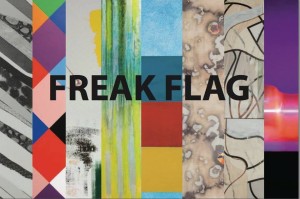
Brian Morris Gallery is pleased to present Freak Flag, a multimedia installation featuring work by James Clark, Craig Fisher, Marthe Keller, Al Loving, Noah Post, Ann Shostrom, Gwenn Thomas, Kim Uchiyama, and Stephen Westfall. Paintings by Paul Corio and drawings by Andy Mister are in the reception area. Freak Flag inaugurates the new Brian Morris Gallery Midtown, in the 1889 landmark Grolier Club building located at 29 East 32nd Street.
Freak Flag exuberantly challenges the culture of normalized war in the name of democracy. The glory of Steinbeck’s free human spirit is in danger. Our individual identities and ‘free’ exploring minds are paramount to the survival of the American experiment. Artists live their revolution with constant practice amidst a landscape of destruction and conflict. This discipline serves creation – Freak Flags flying high for invented nations. They celebrate and champion “the free, exploring mind of the individual human…the most valuable thing in the world.”
The work of Al Loving (1935-2005) embodies the collective theme of the exhibit. Having been in New York for only a year, he was the first African American artist to receive a solo show at the Whitney Museum. Originally from Detroit, Loving felt mired in the institutional fame that was the hallmark of his early career, in which he had a museum show, art world fame and more commissioned work than he could produce. Loving had to remain true to himself as an artist. He had to let his “freak flag” fly. The resulting works, such as Bird on Bird No. 3, are as relevant and meaningful today as when he began creating them in the 1970’s.
James Clark’s sculpture is a shaft of light – an amalgamation of polyethylene bags, fans, metal, fluorescents and motion sensors that hangs suspended from the ceiling. Clark’s Untitled, is both totem and beacon — illuminating, uplifting and absurdly responsive.
Craig Fisher’s Dropcloth Painting expresses the freedom of bodily, rhythmic process by working across a long piece of fabric on his studio floor. Paint is applied to both the front and back of the canvas and pushed through, resulting in a galactic interaction of physical and spatial planes.
Marthe Keller’s ALP II is seductive, but its meaning is intentionally undermined by chance and idiosyncrasy. Her layered work explores painting as an internal contradiction: vertical brush strokes repeat, but progressively evolve; metallic pigments attract, but defy easy interpretation.
Noah Post’s Seconds Fall is made on wood panel. He uses two razor blades to cut across the panel, which is then layered with paint, ink and plaster. His process of application and erasure creates elusive, complex imagery, seemingly etched into its support.
Ann Shostrom’s work blends multiple practices of sewing, dying, staining, and embroidery, using dyes, wax, bleach, and thread to work on cotton fabric. In layering these processes and materials, Colony is a village blueprint, laid out map-like across the shared territories of fine art and craft.
In Large Q, Gwenn Thomas reconstructs torn pieces of fabric, photographs them, and then prints the photographic emulsion on stretched linen. By replicating an extant collage, Thomas gives us the Proustian experience of revisiting the past, conflating it with new perspective and meaning.
Kim Uchiyama’s painting could be seen as a universal flag, comprised of color bars stacked in layers that gracefully mark contrasting qualities of light and weight, arriving at a mysterious open place. Light Study #28 expands well beyond its boundaries, evoking something larger that resonates over time.
Stephen Westfall’s Time Will Tell Us What To Do uses pattern and color to create a kaleidoscope-like fragmentation and unity. Color shapes vibrate against each other, initially jumpstarting the eye, but always coalescing into sign, and ultimately symbol.
“Freak Flag” hangs October 16. Let your freak flag fly!
Brian Morris Gallery Midtown
29 East 32nd Street (between Park and Madison)
347.261.8228
Monday – Friday, 9 – 5
Saturday, 12 – 5
Brian Morris Gallery LES
163 Chrystie Street (between Delancey and Rivington)
347.261.8228
Wednesday-Sunday 12-6 pm