For her first solo exhibition at Perrotin Shanghai, and in China,
Danielle Orchard revisits the history of still life to reframe female
corporeal representation. Her arresting and often humorous
images combine the visual language of modern art with everyday
realities of contemporary womanhood. While rendered with the
saturated palette of Impressionism and sharp contours of Cubism,
in Orchard’s paintings, subjects are freed from the rigidity of
painterly tradition. Is It Light Where You Are? marks the artist’s
fourth solo exhibition with the gallery.
From her Massachussetts studio, Danielle Orchard paints quietly charged,
domestic scenes of solitude. If there’s an immediate sense of familiarity to
her paintings, it’s because she riffs on the great modern masters: Matisse,
Picasso, Hopper. But, with a disruptive brush, she assimilates their
symbolism only to reclaim reality through her own contemporary lens.
Central to Orchard’s practice are notions of the muse, represented
as a reclining female nude throughout centuries of art history. Having
previously life modelled herself, Orchard complicates traditional ideas
of women as passive objects of desire. Instead, her sculpturally-formed
figures – pictured from surprising viewpoints and often from above –
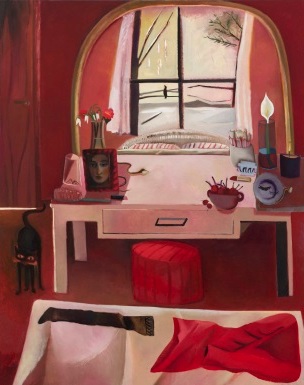
are unposed, and unguarded. However, in this new series, women are curiously, and strikingly, absent. It’s as if the missing subject has just
walked away from her dressing table, departed the kitchen table, or left
her unmade bed, as is the case in Is it Light Where You Are? (2024),
from which the exhibition takes its title.
Illuminating the space is a glowing oil lamp, which has been lifted from a
Balthus painting. Frequently taking such art historical references as her
starting point, Orchard asks, ‘what could I add to this?’. On this occasion,
the flame has attracted a fragile, white moth, bringing quiet tension to the
empty bed scene in which there is no dreaming muse to be found within the sheets.
On the surface, Orchard’s sitter has evaded all depiction. Yet, as the artist
points out, “The female protagonist is still present” throughout the series.
She appears in a framed photograph, a lipstick-stained wine glass, a red
jacket. With such signs of life, it’s as if she has just stepped outside of the
frame, adding mystery to the tableaux she’s left for the viewer to interpret.
Removing bodies has also given Orchard the freedom to emphasise other
psychological elements in these compositions, in which she has brought
previously background items to the fore. Still life has always been important to the artist, who imbues common objects with drama and meaning, allowing them to convey emotion, as they do more than ever in this series of moments between events.
The table set theatrically for two in Morning Daggers (2024) creates an eerie atmosphere. Placed on a crisp plain tablecloth are no forks, only knives, their sharp ends painted red. Is this jam or something more sinister? The viewer is left to wonder. A single, staining drop suggests there is more to this breakfast than first meets the eye. Served up on small plates, eggs hold yet more powerful symbolism, continuing an earlier theme from Orchard’s figurative works in which she used such iconography to address fertility. Yet, there is a timeless quality to her paintings, indicating that it is women’s experiences, more broadly, that she is interested in portraying.
In other images, still life objects stand in more directly for the female
form. The human-sized tulips in The Flood (2024) have sprung to
anthropomorphic life, blooming huge and heavy heads, which wilt as it rains outside. Meanwhile false eyelashes discarded in a small dish in Snow Drops (2024) act as a metonymic portrait, holding noirish potential.
Light, too, assumes a metaphorical role inside Orchard’s rooms, playing on
walls like thoughts inside the mind. Slicing through each of the lusciously
painted scenes are geometric shadows and angular light patterns, their
dividing lines seeming to represent half-remembered, half-told memories or dreams.
Having developed a more metaphysical and abstracted approach for this
body of work, the artist has consciously sought to invoke “sensations of the
dream” by making unusual colour choices, disorienting her viewers. The loud yellow walls of a bathroom, in which the taps have been left running, contrast with a bedroom painted hot pink. At times, she has added to ambiguity sources of artificial light, inviting questions about the time of day or night: is someone up early or late?
Orchard has also conjured notions of the uncanny and unease by casting
symbolic creatures as sidekicks to the furtive heroines within her enigmatic
interiors: a black cat stalks between several scenes, while a lifeless bird
appears to have drowned in its own water bath in Sight Rhyme II (2024),
carrying the feel of a dark fairy tale.
In Evening Chimera (2024), torn and overlapping drawings reveal
chimeric faces in an open sketchbook. Formed by chance, these
composite creatures invoke the surrealist artists who allowed images
to emerge from automatic drawings or rubbings. Representative of the
potential of the unbridled imagination, they also point to Orchard herself,
a painter who stays up late to work.
Like her subjects, Orchard is not represented directly in the frame. Freeing
women from all possibilities of a voyeuristic gaze, the artist reveals more
about their interior lives. Painting psychological portraits – defined by an
interplay of dark and light, the real and imagined, visible and hidden – she
unsettles viewers’ expectations through disquieting narratives from, and
about, the female perspective.
Text by Ruth Millington
Art historian, critic and author of MUSE